Proxima Centauri
May 31, 2026

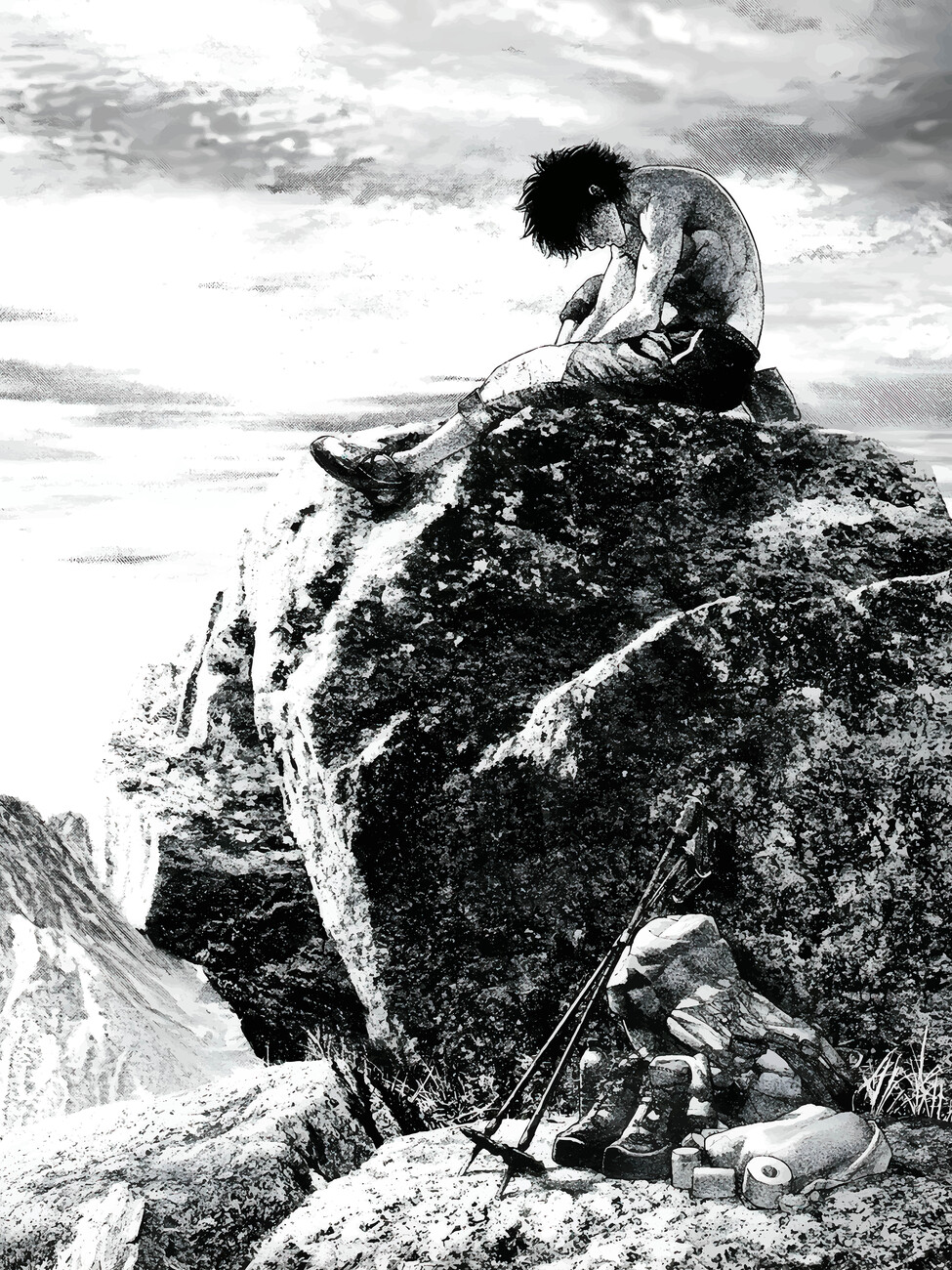
Proxima Centauri is the closest star to us, and it is still impossibly far. Four light-years of nothing. Some goals are like that. Close enough to fix your eyes on, far enough that no amount of walking seems to shrink the distance.
I always knew the stars were there. That was the strange part. On my planet, almost no one looked up. Most people did not know anything existed beyond it, and the few who did never thought to aim for it. I was the one who could see the light and could not understand why no one else was reaching for it.
✦
I was born in a third world country, in a corner of it that sat on the way to nowhere. Almost no one around me spoke English. Everyone I knew was busy with the day in front of them. The next paycheck, the next meal, the small repeating business of getting through the week. The horizon ended at the edge of town and no one seemed to mind.
But my head was somewhere else. I lived on the internet back then, half my mind always in a window pointed at the rest of the world. I read what people far away were building, watched lives that looked nothing like mine, and absorbed a world I had no physical access to. The outside existed, vivid and detailed, just on the other side of a screen. I saw enough of it to know there was something extraordinary out there. Not enough to feel like I had any natural path into it.
That was the tension. The screen had shown me the ceiling of the world, and then I had to go live under a much lower one.
Where I grew up kept its own score, and it was a small board. You did well if you got into a decent university. You did very well if you landed a job at a company people had heard of. Those were the peaks everyone around me climbed toward, and reaching one was supposed to be the end of wanting.
I could not make myself want it. The internet had already ruined the local scoreboard for me. I was not measuring myself against the best kid in my town. I was measuring myself against the best in the world, against names and faces I only knew through a screen.
It was never a clean comparison. I had no map and no real sense of the distance. But I knew there were people operating at a level so far past my world that the whole local game felt like a children’s bracket. Elite schools, fluent English, global competitions, networks they were simply born inside. They inherited the pathways I was trying to assemble from scraps.
That is where the self-pity lived. Not because I thought my world was everything, but because I knew it was not. I had seen the real game with my own eyes. I just felt born on the wrong side of its gates.
So winning locally split me in half. Pride, because I had beaten everything in front of me. Resentment, because everything in front of me was never the thing I was actually trying to beat.
I was climbing local maxima while measuring myself against a global peak.
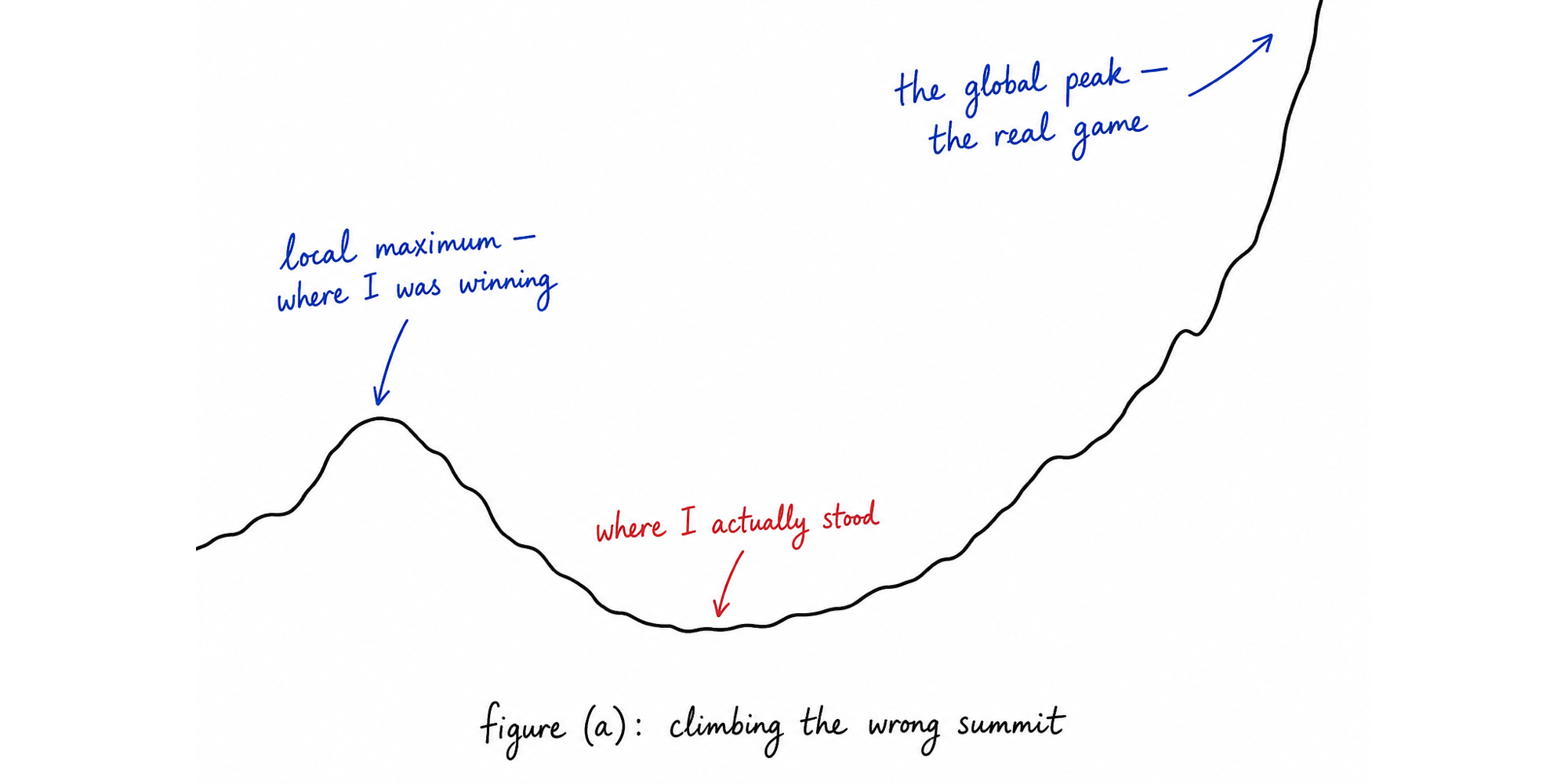 Local maxima feel like summits until you see the global one.
Living in that gap warps your self-image. You end up proud of how hard you worked and ashamed of how little it bought. You know you have come a long way from where you started, and yet the thing you are actually reaching for has not moved an inch closer.
It was never that I confused winning locally with winning for real.
It was that I saw the gap too early, and could not unsee it.
Delta
In finance, there is a concept called delta.
Delta is a slope. It measures how much a position changes when the underlying asset moves: if the underlying moves by one, how far does your position move? Change in output over change in input, nothing more.
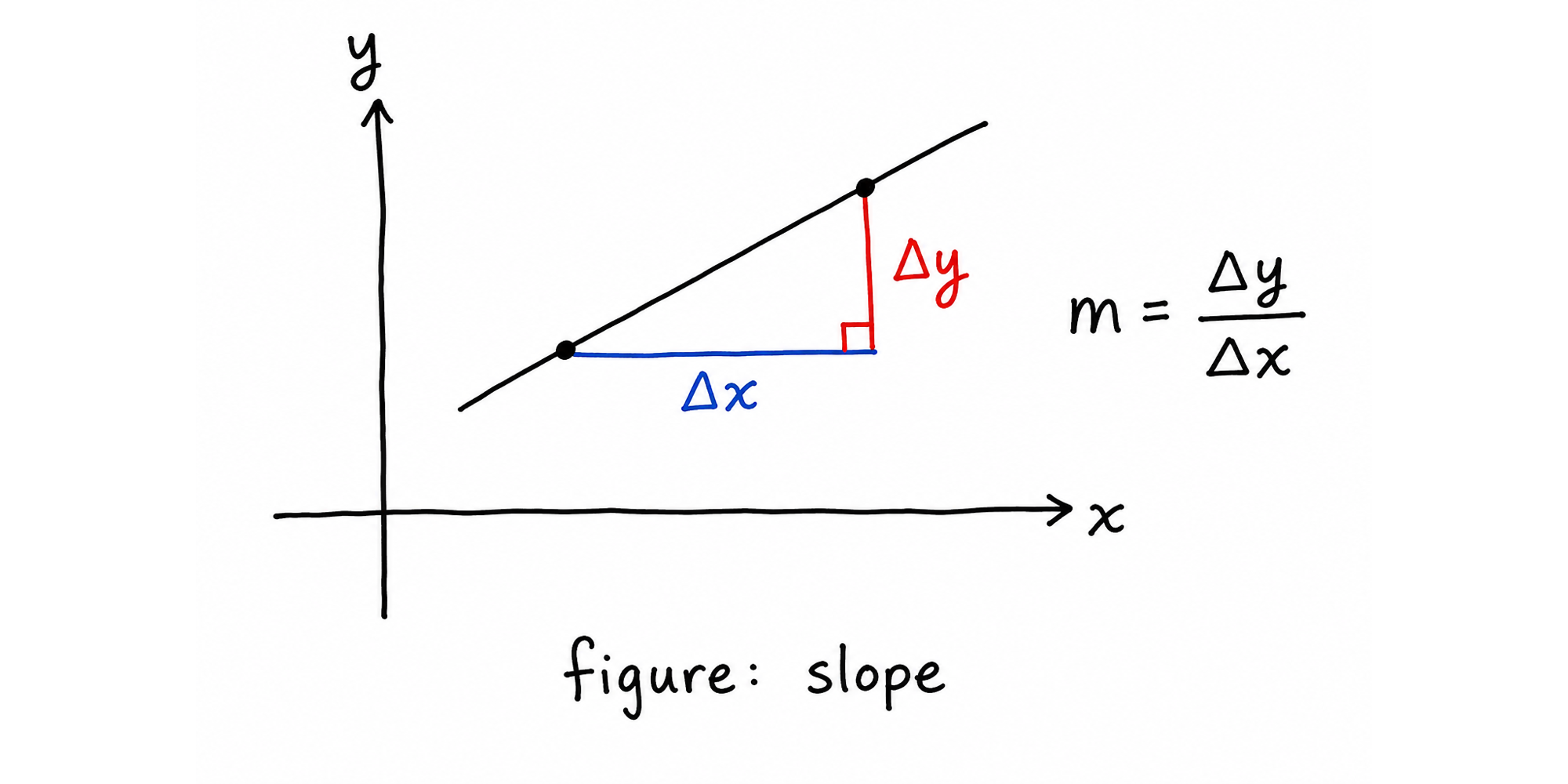 Delta is just slope: change in output over change in input.
So delta is not the total value of the position. It is the steepness of your response, the change measured relative to a reference point.
For most of my life, my delta started negative. Most people around me seemed neutral, or at least close to zero, and some were already positive before they had done anything, their starting conditions moving with the world while mine seemed to move against it.
So before I could even think about level, I had to make up the deficit from origin. I was not trying to get ahead yet. I was trying to get back to zero.
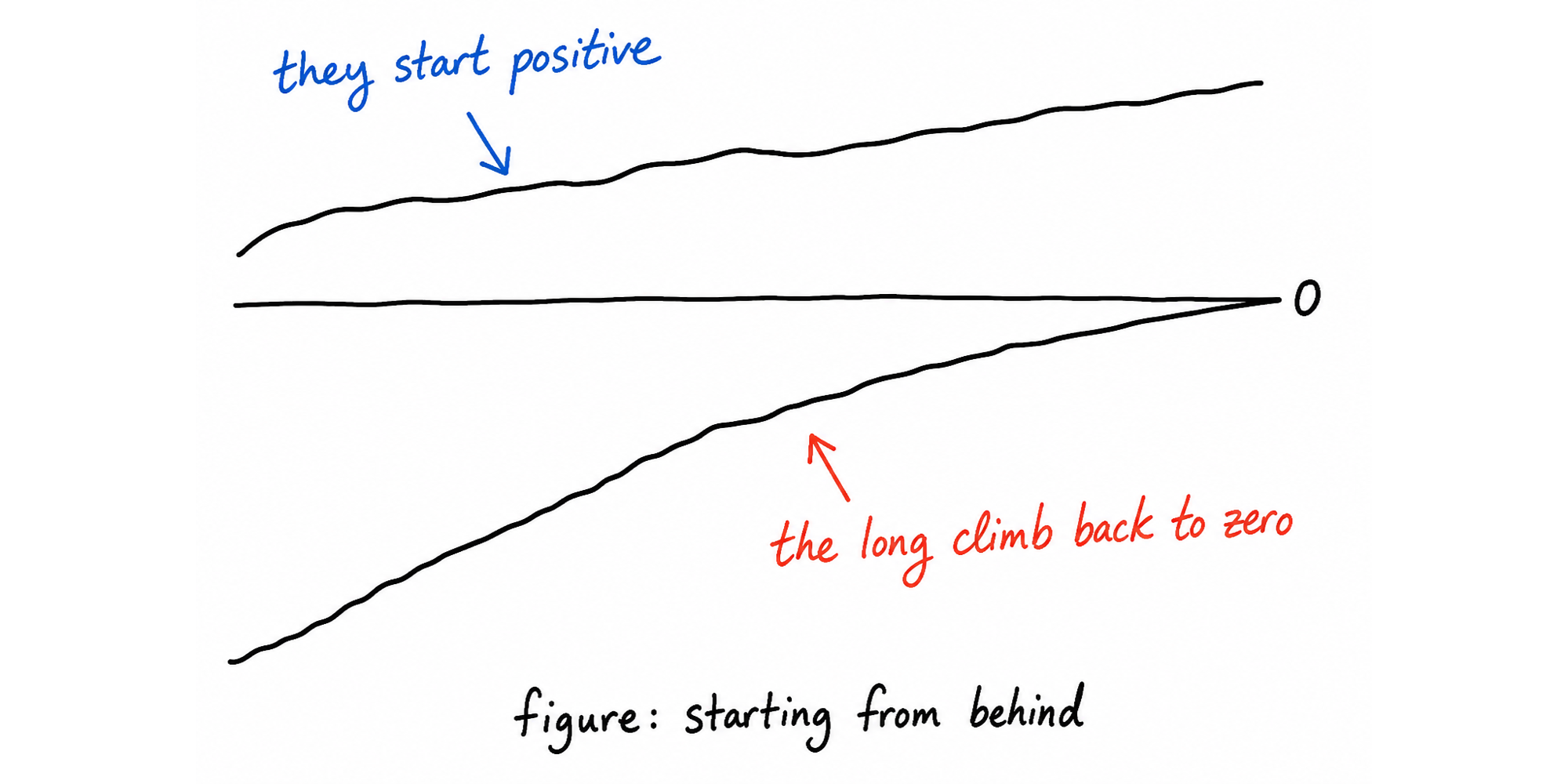 The long climb back to zero, while others start positive.
How far had I actually moved?
From where I started, it looked like a great distance. No English around me, no pipeline to anywhere, no one who could make the world legible the way it seemed to be for other people. And I had moved, just not as far as it felt. All of it only carried me to where they began. I had spent everything I had to reach their starting line.
Still, I had earned it. I had beaten kids with private tutors and far less to worry about. I had taken myself seriously when nothing outside me asked me to. And I knew what that cost. Not discipline in the cosmetic sense, but actual reformation: changing how I spoke, what I consumed, what I cared about, what I let myself want. No one did that for me.
So I was proud. But the pride never came clean. The others were not solving the problem I was solving first. They never had to make themselves compatible with the world before competing in it. They were already inside the room I was trying to enter. The ground I crossed to arrive was simply where they had always stood.
That was the difference. I was paying off a debt I never took on. They were compounding a surplus they were handed. I worked to get to zero. They worked from a balance that was already positive.
It bothered me long before I had words for it. It sat in the background as comparison, sometimes useful, sometimes embarrassing. I told myself I was only focused on my own path. That was a lie.
I was always measuring myself against them.
Gamma
In my line of work, I started meeting people who made the gap harder to ignore.
People with elite schools, fluent English, no financial worries, parents who understood the game. People who talked about global universities, internships, fellowships, startups, finance, research, networks, whatever, as if these things were normal objects in the room.
I would talk to them on calls, read their work, sit in meetings, watch how they framed problems, and start comparing.
Their achievements, mine.
Their ambition, mine.
Their reality, mine.
At first, I almost wanted the gap to be about ability. If they were only smarter or more disciplined, then the answer was simple: become better. Work harder. Close the distance.
But it did not feel like ability alone.
The difference was not only effort, diligence, or discipline. Their starting conditions changed how fast effort could compound.
This is where gamma helped, though I only understood it much later.
In finance, gamma is the rate at which delta changes. It is convexity. It is what makes upside accelerate instead of moving in a straight line.
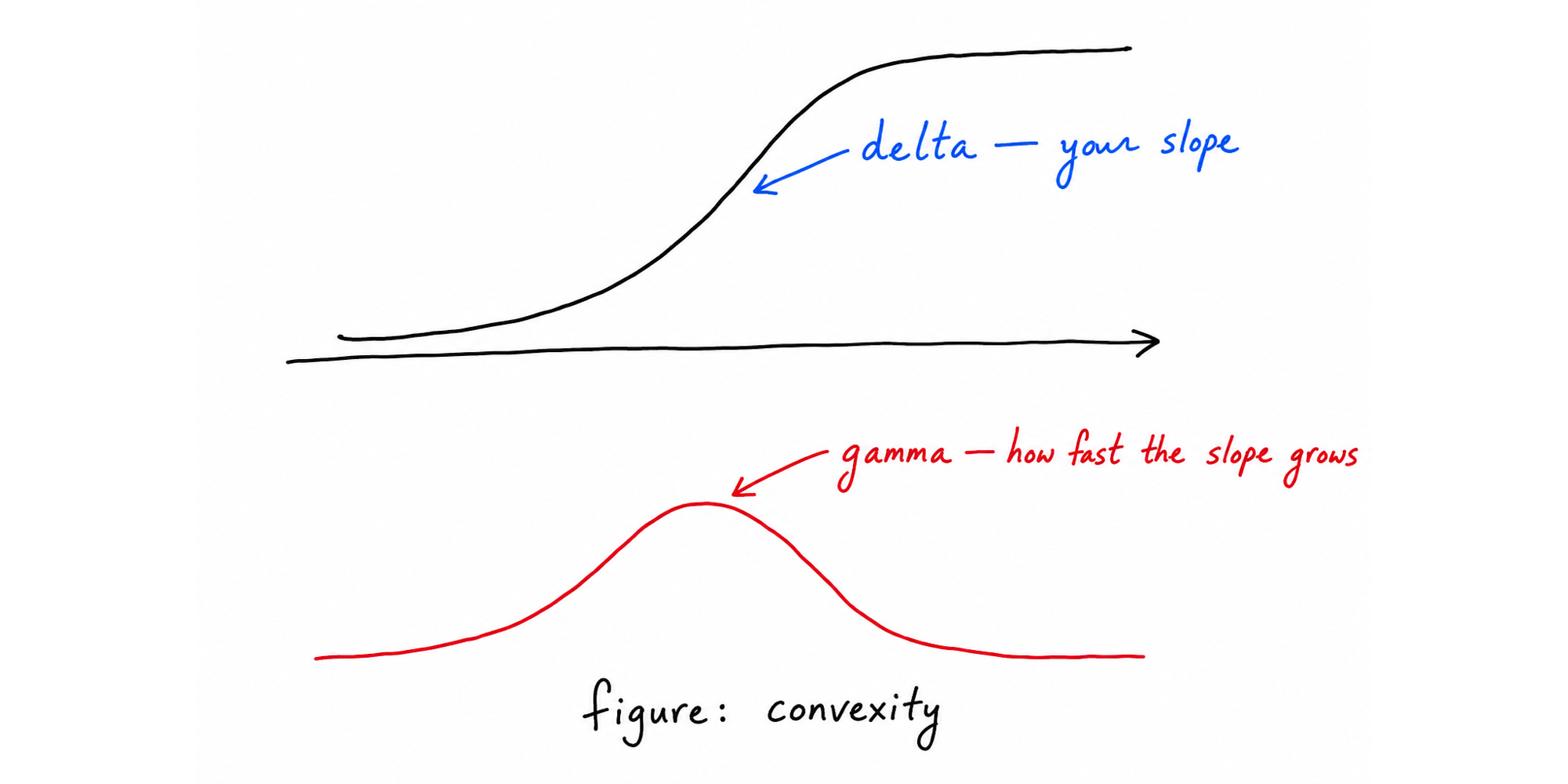 Delta rises with the underlying; gamma is the curve of how fast that delta changes.
Their progress felt convex. One opportunity created the next. One credential opened a room. One room created a network. One network made the next opportunity easier to access. Mine felt linear. Work harder, move further, repeat. Same effort, different shape.
And they were not incomprehensible. For a long time I had imagined people like that as operating from some different cognitive plane. Better taste, better instincts, better map, better everything. Some of that was true. But not all of it. I could follow their reasoning. I could understand how they framed problems. Our understanding overlapped more than I expected. The difference was not that they were alien and I was local. It was that their world had made certain paths obvious earlier. They had inherited more of the map. I was still drawing mine while trying to move through it.
Here is what I got wrong for years. I was so fixated on how far ahead they were that I never looked at my own slope. I only measured the distance still between us, never the rate at which I was closing it. Every comparison became evidence against me. I would talk to one of them and walk away convinced I was behind, slow, born too far back to matter. I punished myself with it.
What I could not see was that my delta was already changing. My own gamma was rising. The early years looked like falling behind because a steep curve dips before it climbs. I spent down whatever I had, took on things that did not pay back for a long time, and watched the line go lower before it went anywhere. I read that as proof I was losing. It was the cost of buying a steeper slope.
 The dip. Pushing forward while everything tells you that you are losing.
Then the curve did what curves do. The work compounded. One thing I learned made the next faster to learn. One small result earned a little credibility, the credibility opened a door, the door made the next door cheaper. The convexity I had envied in them started showing up in me, years later and from further down, and I was too busy beating myself up to notice it had begun.
By the time I looked up, I had started to outpace some of them. Not all. But some who began ahead had also stopped climbing, comfortable at a level that was handed to them. My slope was steeper because I had spent so long building it, and past a certain point a steep enough curve catches a high enough starting position. The gap I had treated as permanent, the one I had used to torture myself, had quietly been closing the whole time.
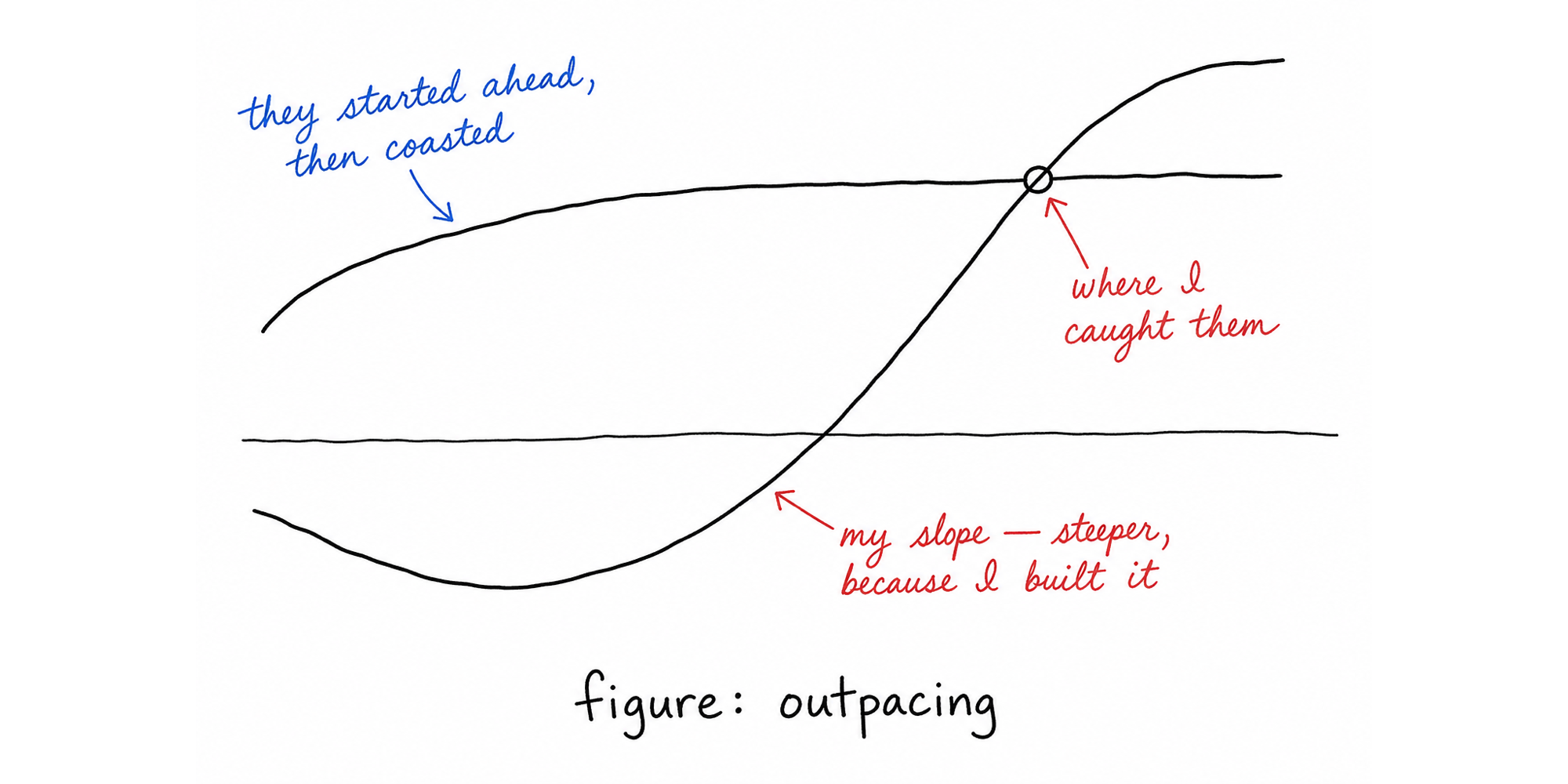 A steep enough slope catches a high enough head start.
It did not make me feel like I had arrived. It made me want the top. Catching people who were once impossibly far ahead only showed how many were still above them. The same hunger that dragged me to zero, then past it, did not switch off when I drew level. It pointed up.
One must still have chaos in oneself to give birth to a dancing star
Friedrich Nietzsche
People call it pressure. The need to perform, the competition, the low hum of anxiety, the fear of coming up short. And it is that. But pressure is too soft a word for what I mean.
What I mean is that the benchmark itself is unstable. Whether you are winning or losing was never fixed. It depends entirely on which reality you are being measured against, and that reality can move beneath you without warning.
For most of my life the reality I measured against was where I came from. The version of me who was not supposed to make it out. Against that, I had clearly won. Then I stepped into a different reality, and the ruler bent in my hands. What I had been proud of did not become a lie. It just became partial. I had not been wrong to value my delta. I had only confused it with my level.
Delta from origin is a warm number. It makes you grateful and disciplined and hungry, and it hands you a story you can live inside. Level is colder. It does not care where you began, or what it took, or that almost no one around you spoke English, or that every inch had to be carved out of yourself. It asks one thing, and it does not wait for your excuses. Where are you now.
That question can take you apart. The worst of it is the moment your own valuation breaks, when you realize you had been pricing yourself against one world while the real one had been pricing you against another the whole time.
The world hands you two cheap exits. Resentment, where you spend years building a moral case for why your slope should count more than their level. Sometimes the case is even true. Truth does not make it useful. Or collapse, where the game turns out bigger than you priced in and your old pride looks like a kid bragging about a local tournament before he learns the sport has a world circuit.
i'm taking neither.
so here is what i have to say to the world that priced me out at birth.
you dealt me the worse hand and called the game fair. you set the bar somewhere i could never touch it from where i was born, then graded me for coming up short. fuck that. keep your ruler. i never needed you to move it.
here is the thing you never understood. a benchmark is just a line some comfortable hand drew, and anything drawn can be torn up, dragged, set on fucking fire. i am the one dragging it now. the nowhere i crawled out of already beat that into me. it gave me the one thing none of those soft fuckers ever had to earn. the bone-deep certainty that i can claw my position to wherever i want it by sheer fucking will, with nothing, from nothing. they were handed the map in the cradle. i bled mine into existence one inch at a time.
that is the better weapon, and i have ground its edge against my own bones my whole life until it cuts through anything. so come watch. come fucking watch me drag that line past every last one of you. i will claw up there screaming with my hands torn open and plant myself somewhere none of you ever dared to look. and when i reach it i am going to look back down at the little bar you set for me and laugh until it hurts. you built a cage and called it the sky. let me show you how fucking small it always was.
So no, the origin story does not get to be my ceiling. I stopped asking how far I had come. I started asking how far this can possibly go. There is no comfort in that question. It strips away the shelter of the personal curve. You can honor the delta, you can remember every cent it cost you, but you do not get to hide behind it forever. The world will not grade me on my background, and I have stopped asking it to.
Starting points matter. They matter brutally. But character and will are mine, and they are not small. They let me survive one benchmark, outgrow it, and survive the humiliation of seeing a larger one waiting behind it.
So to the world that decided where I was supposed to stop: I am still coming.
I am going to chase the one point of light that has stayed impossibly far away my entire life. Proxima Centauri. Four light-years of nothing between me and it, and no ship that goes there. No one is holding a seat for me. No pipeline, no inheritance, no map, no hand reaching down to pull me up.
Fine.
I will build the spaceship myself.